


ㅤ
Health Magazine/Health & Medicine/Neuropathy Progression
14 min read
It Started in Your Toes. Now It's at Your Ankles. The Real Reason It Keeps Climbing Has Nothing to Do With Your Blood Sugar Anymore.
Gabapentin was never built to stop the advance. But a four-year trial across 36 medical centers found something that did, on paper, in the clinical measurements. Prescribed in Germany since 1966. Here is why your doctor never mentioned it, and why the bottle you already tried couldn't do the job.


Updated September 2026 · Sources: NATHAN 1, SYDNEY 2, ALADIN I (linked at the bottom)
3:10 in the morning. You're sitting on the edge of the mattress with your feet on the carpet, because the sheet touching them feels like gravel and glass, and the little fan you keep on the floor is the only thing that helps.
Your wife is asleep behind you. She's learned not to ask anymore.
And somewhere in that dark you catch yourself doing the thing you do every few weeks now: you press a thumb into your shin, a little higher than last time, to check where the numbness stops.
That's the part nobody tells you about neuropathy. It's not the pain that changes who you are. It's watching the line move.
You Already Know Where the Line Is Going. Here's the Year It Starts Costing You Things.
You remember when it was just your toes.
A little tingling at night. A cold patch that wouldn't warm up. Easy to blame on a long day, a tight pair of shoes, getting older. You mentioned it once at a checkup and got a nod and a note in the chart.
Then it moved. Not fast. It never moves fast. It moves like water finding its level, a little higher every season, so slowly that you only notice it when you compare this year to last year.

The ball of the foot. That's when the burning started, the kind where you aim a fan at the foot of the bed in January.
The heel. That's when the floor stopped feeling like a floor. One Root of Nature customer described it as "walking on marshmallows." Another said "walking on the bone." Both are right.
The ankle. That's when you stopped trusting the pedals.

You didn't decide to stop driving. There was a Sunday when you couldn't tell if your foot was on the brake or next to it, and you handed her the keys in the church parking lot and made a joke about it. She didn't laugh. You both knew what it was.
And then the calf. That's the rung you're on now, or the one you can see from where you're standing. That's when the hand goes flat against the hallway wall on the way to the bathroom.
That's when the grandkids run across the yard and you grip the back of the patio chair and smile and say grandpa's tired today.

Your wife carries the groceries now. She doesn't say anything about it, which is worse. The after-dinner walk quietly turned into her walk. The porch chair you used to start the morning in has a heating pad on it.
There's a word you haven't said out loud. You think it at 3 a.m., when the fan is running and the line is a little higher than it was. It starts with A. You push it back down.
Because here's what the line is actually taking, rung by rung:
- Your sleep.
- The floor under your feet.
- The keys.
- The yard with the grandkids.
- The man your wife married, the one who carried things.
Most people reading this have been told, in one way or another, that this is just what diabetic neuropathy does. It climbs, you manage the pain, and the rest is between you and God.
What almost nobody has been told is that in 2011 a team of researchers finished watching 460 people for four straight years to answer one question: can the climb be stopped? The answer they published is the reason this article exists.
Get the German Protocol600mg stabilized R-ALA · 60-day guarantee
The Road You've Already Been Down (And What Each Stop Cost You)
I'm going to guess you've been down the same road as the patients who write in to Root of Nature. Tell me if I miss a stop.

You know that table. Every one of those things helped for an evening, or a week, or not at all. The baths and the creams worked on the skin, and the skin was never the problem. The vitamins were harmless and did nothing.
The prescriptions took the edge off and, for a lot of people, took their words and their waistline with it. The bottles from the TV ad and from Amazon promised nerve support and delivered heartburn. None of it was a mistake to try. It just wasn't built for what's actually happening in your feet.
Add it up honestly and most people land somewhere north of a thousand dollars, spread over enough years that it never felt like a thousand dollars. And the line kept climbing the whole time.
Then there's the last stop, the one your neurologist mentions carefully: the spinal cord stimulator. An implanted device, a surgery, a bill that runs into five figures. It doesn't touch the nerve in your foot.
It jams the pain signal on the way to your brain. Ask what it does for the numbness, the balance, the climb itself, and you'll get the same look you got when you asked "will this ever get better?"
A patient described that look better than I can: "It is what I call the blank look."
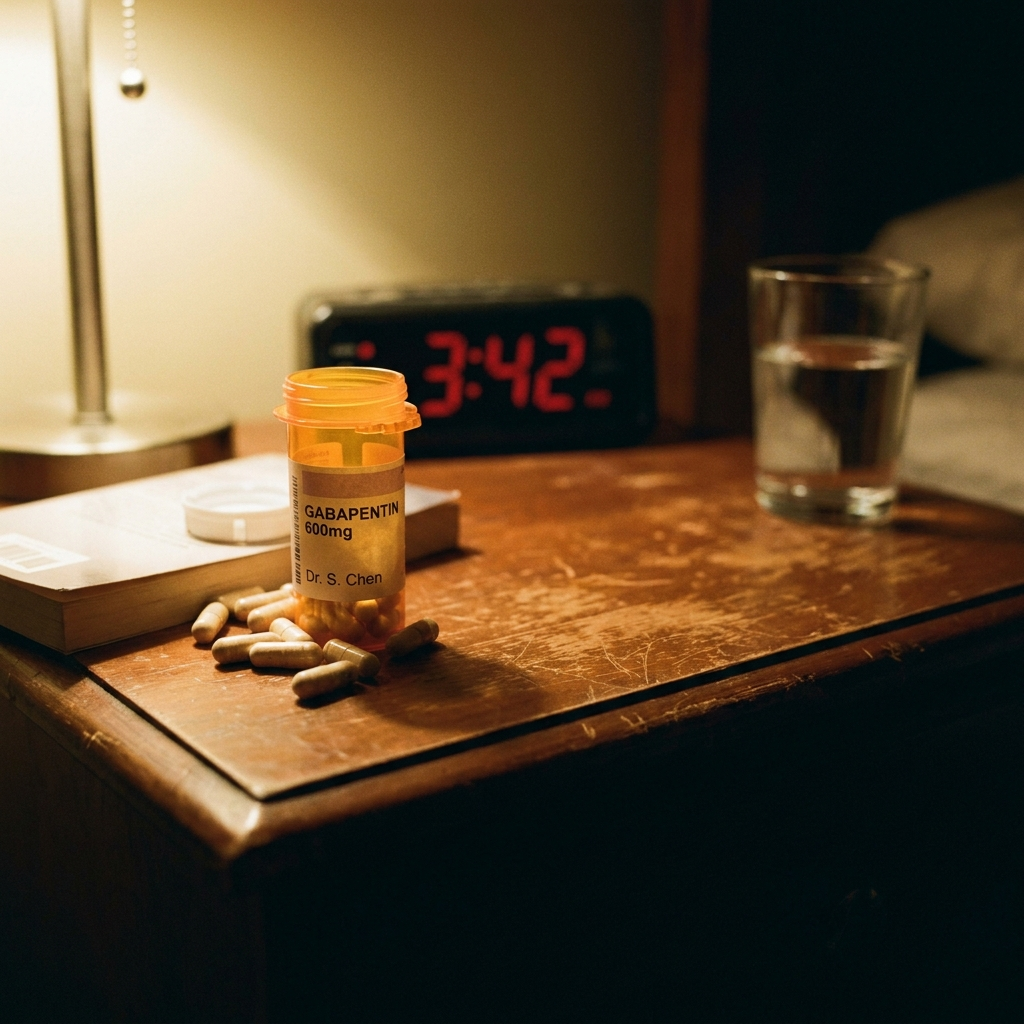
Read that road again. Every single stop on it was built to do one thing: make the pain quieter. Not one of them was built to stop the line from moving.
The American protocol manages your neuropathy. It was never designed to halt it. That's not your doctor's fault. It's the only toolkit they were handed.
Two words to say to your spouse tonight, because they explain everything that follows: still climbing.
Which leaves the question you've been carrying for years. If you controlled your sugar, took the pills, did the baths and the socks and the vitamins, then why is it still climbing?
Your Feet Aren't Dying. They're Browning Out.

The clearest explanation of what's happening inside your feet doesn't come from an American clinic. It comes from Düsseldorf, Germany, where a neurologist named Dr. Dan Ziegler has spent about thirty years studying one molecule against one condition.
There, diabetic neuropathy has been treated as a problem of supply, not just of sugar, since the 1960s.
Here it is in plain language.
The nerve that runs to your big toe is the longest wire in your body. It leaves your lower spine and runs, unbroken, about three feet to the tip of your foot. Every signal, and every bit of energy and protection that nerve needs, has to travel the whole length of that wire.
Years of high blood sugar did two things to that wire. It started a slow chemical fire inside the nerve cells, the kind doctors call oxidative stress, that burns through the cell's own defenses. And it damaged the tiny power plants inside the nerve, the mitochondria, that keep the signal running.
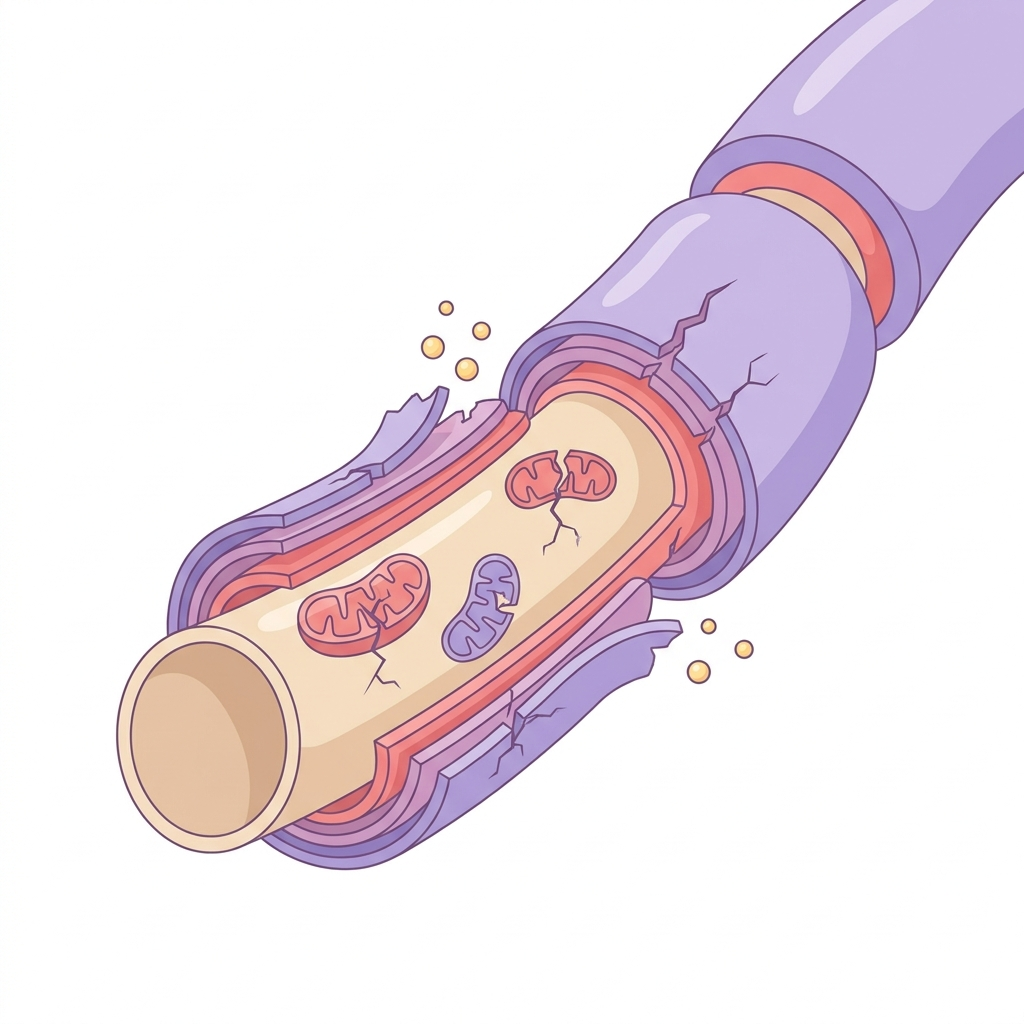
Now think about what happens to a long power line when the supply drops. The lights nearest the source stay bright. The lights at the far end of the line dim first. Then the dimming creeps back toward the source, one lamp at a time.
That's your feet. Toes first, because they're the end of the line. Then the ball of the foot. Then the ankle. Then the calf. Neurologists have a name for it: length-dependent neuropathy. The nerve doesn't die from the middle. It browns out from the far end back.
And here's the part that explains your last ten years: the fire doesn't go out when your blood sugar comes down. Once it's running, it feeds itself.
The defenses are gone, the power plants are failing, and the far end of the wire keeps going dark, one inch a year, even with a good A1C. That's why controlling your sugar was necessary and still wasn't enough.
It shut off the thing that started the fire. It didn't put the fire out, and it didn't turn the power back on.

The burning, the tingling, the pins and needles? Those are the flicker before the lamp goes dark. The numbness is the lamp going dark.
Now go back down the road you've been on, because every stop finally makes sense:
- The baths, the creams, the massager warmed the surface. The wire is browning out from the inside.
- Gabapentin turns down the flicker so you can sleep. It does nothing for the supply. The lamps keep going dark, quietly, while the alarm is muted.
- The B vitamins are a real part of nerve health. They just aren't the part that's on fire.
- The spinal cord stimulator jams the signal near the source. The far end of the wire is still starving.
- The Amazon alpha lipoic acid was, in principle, the right idea. It was also the wrong molecule, at the wrong dose, in the wrong capsule. I'll show you exactly how in a moment.
None of that was your fault. You were handed tools for the flicker and asked to fix the wiring.
Which turns your question around. It's no longer "how do I make the pain go down tonight." It's "how do I get supply back to the far end of the longest wire in my body?"
Get the Real R-Form600mg stabilized R-ALA · 60-day guarantee
The One Molecule That Reaches the End of the Line, and Why the Bottle You Tried Couldn't
Let's do the research for you, because you're about to do it anyway.
In Germany, a compound called alpha-lipoic acid has been a prescription drug for diabetic neuropathy since 1966. Not a supplement. A prescription, written by neurologists, covered by insurance, sold under the name Thioctacid HR. Sixty years of routine use.

In 1995, a trial called ALADIN I gave 328 diabetic neuropathy patients 600 milligrams a day. 82.5% of them reported meaningful improvement in their symptoms, against 57.6% on placebo. Published in Diabetologia.
In 2006, SYDNEY 2 confirmed the oral form worked, so you didn't need an IV. Published in Diabetes Care.
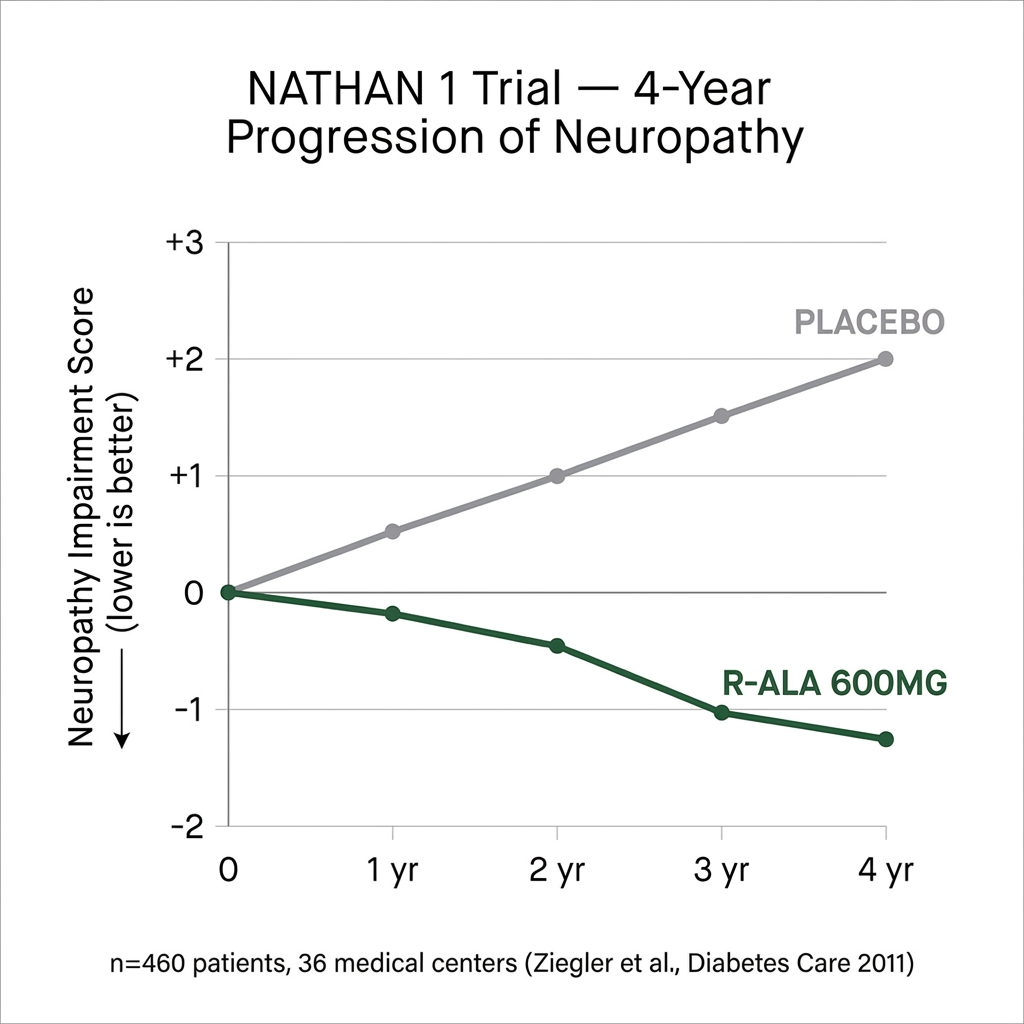
And in 2011, the one that matters for you. NATHAN 1. 460 patients. 36 medical centers across the United States, Canada and Europe. Four years of one 600mg dose, once a day.
The longest and most rigorous trial ever run on whether the climb can be slowed. The published conclusion, in the trial's own words: the protocol produced "clinically meaningful improvement and prevention of progression of neuropathic impairments."
Sit with that for a second. Four years. The clinical measurements of nerve impairment didn't keep getting worse. Not a cure. The nerve you've lost, you've lost. But for someone lying awake wondering where the line will be in four years, that sentence is the whole game.
So why has this never come up in your appointments? Because the molecule can't be patented. Nobody can own it, so nobody funded the American approval process, so it never made the American treatment guidelines, so it isn't taught.
In 2023, American doctors wrote 73 million gabapentin prescriptions. Lyrica at its peak made Pfizer $4.6 billion a year. The decision was economic, not scientific. Your doctor isn't hiding it. Your doctor was never shown it.
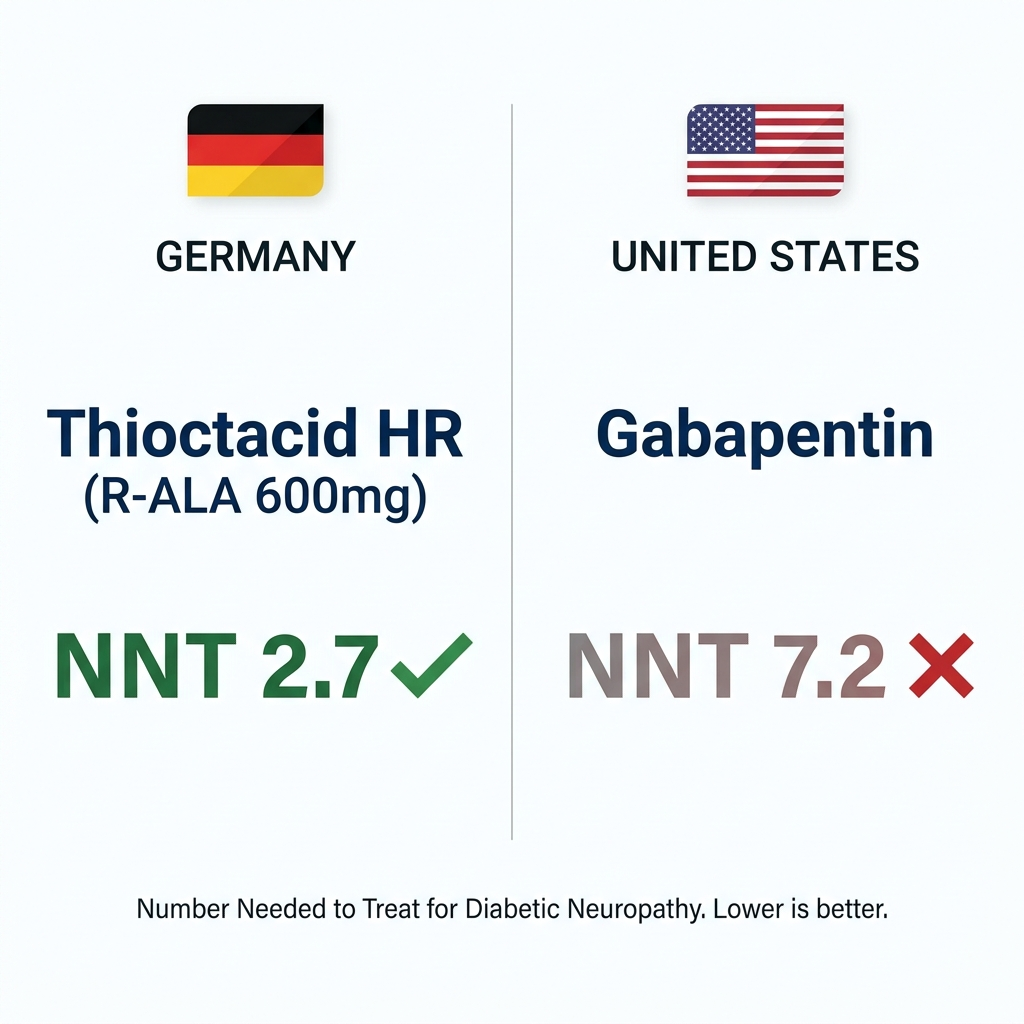
One more number, and then the part about your Amazon bottle. Doctors measure drugs by how many patients have to take it for one to get meaningful relief. Gabapentin: about 7. R-ALA at 600mg: about 3.
The German prescription is roughly 2.5 times more likely to help a given patient than the American one, without the fog, the weight, or the dependency.
Why the bottle you tried did nothing

Gretchen, a nurse and a Root of Nature customer, said it best after three years of trying everything on Amazon: "I started reading about the R-form versus racemic ALA and it was the first thing that actually made sense to me scientifically. Why had I been taking a supplement where half the capsule was working against the other half."
That's the whole story. To reach the far end of the wire, the molecule has to clear three bars, and the pharmacy bottle clears none of them. German neurologists call the version that clears all three the protocol. I'll use their word.
Alpha-lipoic acid comes in two mirror-image shapes. Your nerve cells recognize the R-shape. The pharmacy bottle is a racemic mix: half R, half a synthetic S-shape that doesn't exist in nature and competes for the same receptors. Half the capsule jams the lock the other half is trying to open.
This is the part that puts out the fire.
ALADIN, SYDNEY 2 and NATHAN 1 all used 600mg a day. Most shelf products deliver 100 or 300, and the "nerve" formulas bury it inside a blend. A dose below the trial dose isn't a smaller effect. In the trials, it's the difference between measured and not measured.
This is the part that restocks the defenses: the molecule recharges the vitamin C, vitamin E, glutathione and CoQ10 the fire burned through.
Raw R-ALA breaks down in heat, light and stomach acid, and taken dry it's the reason people quit with heartburn in week one. Stabilized R-ALA in a slow-release capsule survives the stomach, crosses the fatty membrane of the nerve cell, and works in both the watery and the fatty parts of the cell. No other antioxidant does both.
This is the part that turns the power back on: R-ALA is a working part of the mitochondria's own machinery.
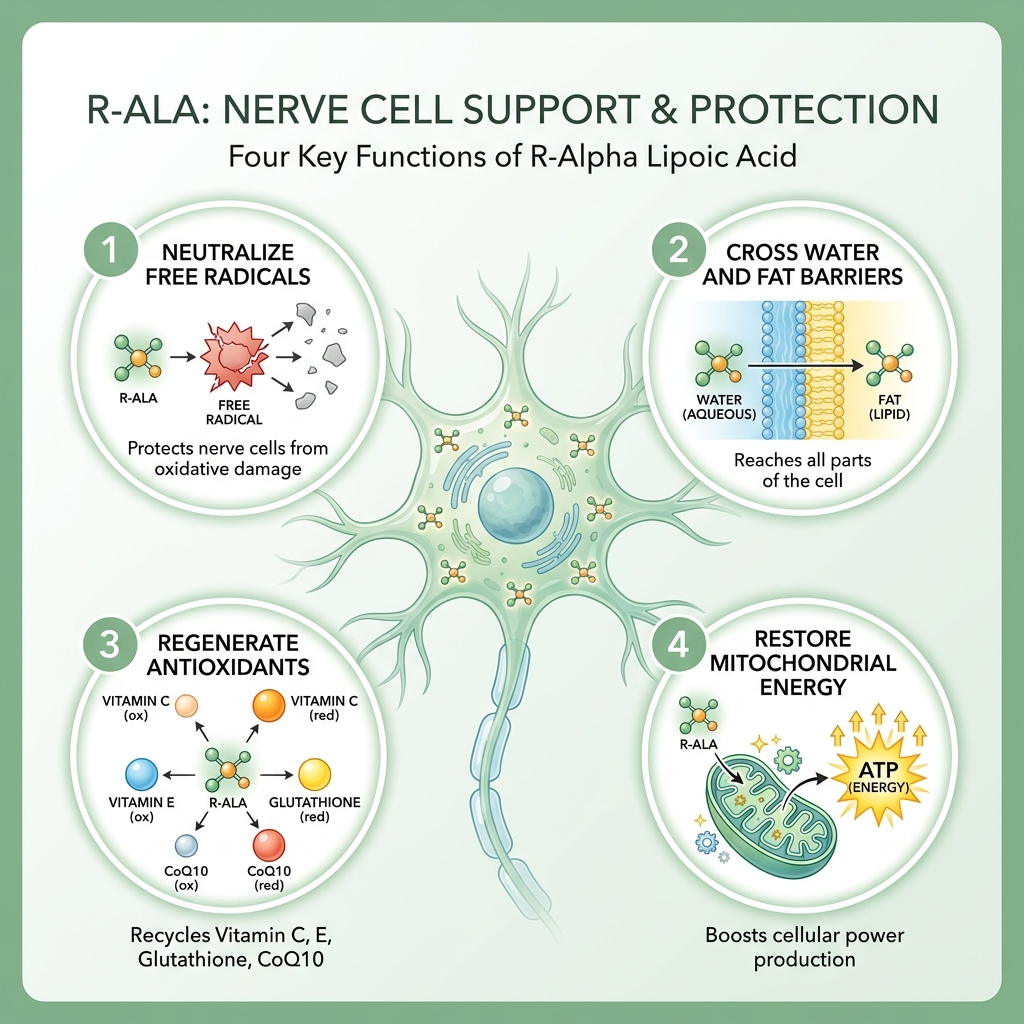
Now the line that protects your wallet. The R-form at 100mg is a whisper. 600mg of the 50/50 mix is half a bottle working against the other half.
Both of them in a dry capsule is heartburn and a wasted month. Only the three together reach the end of the wire. That's why the $15 bottle "didn't work." It was never the protocol.
Margaret R., another customer, got the same instruction from the one place you'd expect it: "My neurologist told me to be sure I got the stabilized R-form, not the cheap 50/50 kind. It was this or gabapentin. I chose this and never looked back."
That instruction, stabilized R-form, 600mg, once a day, slow-release, is the exact specification Root of Nature R-ALA was built to. One compound. No blend. 600mg.
The third-party lab certificate for the R-form percentage and the dose is published on the product page, so you can read the assay before you buy. Try it for sixty days. That's the ask.
Try It Risk-Free for 60 DaysBuy 3, get 1 free
What the First Six Weeks Look Like, in the Words of the People Who Wrote In
Everything above this line is a claim, and you know it. Trials are trials. The question you're actually asking is: does it work for someone like me, on a timeline I can picture? So here is the timeline, built from what Root of Nature customers wrote in. Not one of them loved it on day one.
Day 1 to 14. Honestly? Not much. You take your 600mg. No stomach burn, which is the first thing people notice if they've tried dry ALA before. The line is where it was. This is the part where most people on the Amazon bottle quit.
Week 3. Jimmy, 58, four years on gabapentin: "After about 3 weeks the burning started quieting down. I actually slept 6 hours straight for the first time in years." Gretchen: "The tingling in my feet started fading around week three."
Week 5. Gretchen again, the nurse: "By week five I was completing full shifts without counting down the hours until I could sit down. I am not pain free but I am functional again."
Week 6. Linda, 64, who hadn't been on the floor with her granddaughter in three years: "Six weeks later I was sitting on the floor building blocks with her. I cried the whole time."

The biggest line in Linda's story isn't hers. It's her husband's. "My husband thought something was wrong. Nothing was wrong. Everything was finally right."
Get Your Nights Back60-day money-back guarantee
Now the part that answers the question this article opened with. The line. Carol B., a long-term customer: "I've taken it daily for years and my neuropathy hasn't gotten any worse. I really believe it has slowed the progression, and that's all I was hoping for."
Another, taking R-ALA daily since 2016: "My neuropathy hasn't gotten any worse. At my age I'll take that as a win."
And the test that convinced the skeptics, because you should be one. Jimmy: "I stopped taking it for a month just to test it. Symptoms came back within 2 weeks. Started again and within 10 days I was sleeping again. That test told me everything I needed to know."
Susan, 71, from Asheville, North Carolina, ran the same experiment by accident: "I ran out and didn't reorder for about a month, and the tingling crept right back. Got back on it, and within a few days it settled down again. That's when I knew it wasn't in my head."

Go back to the list the line was taking from you, and read it against what came back:
- Your sleep. Six hours straight, by week three.
- The floor under your feet. Diane, 63, Dayton: "I can feel the floor under my feet again."
- The hallway wall. Frank: "I've stopped staring at the floor with every step."
- The grandkids. The living room carpet, week six.
- The line. Held. For years, in the people who kept taking it.

Try It Risk-Free for 60 DaysFull money-back guarantee
"But What About…" The Five Doubts, Answered by Five Customers
You're holding one specific doubt right now. Everyone is, and it's a different one for each reader. So instead of more benefits, here is one real customer for each.
"I've had this for eleven years. Nothing is going to move it now."
Daniel H. · Verified Buyer · ★★★★★
"Eleven years of neuropathy. Three different neurologists. Two prior brands of R-ALA. This is the first thing that has actually quieted the burning. I don't know what they're doing differently but it works."
"R-ALA burned my stomach last time. I can't do that again."
Robert T. · Verified Buyer · ★★★★★
"Other R-ALA capsules burned my stomach so badly I quit after a week. The slow-release on this one is different. Zero nausea, zero burning. Finally a brand that respected my GI tract."
"I'm on gabapentin. My doctor keeps raising the dose."
Jimmy, 58 · Verified Buyer · ★★★★★
"I was on gabapentin for 4 years. Gained 35 pounds, could not think straight at work, and my feet were still burning every single night. My doctor kept increasing the dose and nothing changed. I started researching on my own and found out about the R-form versus the regular ALA I had already tried. Ordered Root of Nature, took it every night at 600mg. I am off gabapentin completely now. My head is clear, I am down 18 pounds just from dropping the drug, and I can finally feel the floor under my feet in the morning without dreading the day."

"Mine is mostly balance, not pain. Will it do anything for that?"
Frank, 68, Mesa, AZ · Verified Buyer · ★★★★★
"My neuropathy always hit my balance the hardest. I'd hold the wall just to get down my own hallway. A few weeks in, the steadiness started coming back. I'm walking farther, and I've stopped staring at the floor with every step. I feel like me again."
"I've already tried three R-ALA brands. Why would this one be different?"
Patricia R. · Verified Buyer · ★★★★★
"I tried three other R-ALA brands from Amazon and felt nothing. Three weeks on Root of Nature and the burning in my feet at night has dropped to almost zero. I sleep through the night now."
Try It Risk-Free for 60 DaysBuy 3, get 1 free
The four questions people ask before they order
"If this works so well, why hasn't my doctor told me?"
Because it isn't in the American guidelines, and it isn't in the guidelines because nobody can patent a natural molecule and pay for the approval. Your doctor has twelve minutes and a formulary. Keep your doctor. Bring them the NATHAN 1 paper linked at the bottom of this page and ask.
"Isn't this just the Amazon bottle in a nicer package?"
Read the label side by side. R-form only, not racemic. 600mg, not 100 or 300. Stabilized, slow-release, not dry powder. The lab assay is on the product page. If any one of the three is missing, it's a different product, whatever the front of the bottle says.
"What if it doesn't work for me?"
Then you send the bottles back, empty if you like, inside sixty days, and you get your money back. Jimmy used his for three weeks before he was sure. Susan needed to run out to be sure. You get sixty days to run your own test.
"If it really does this, why isn't it priced like a prescription?"
Because nobody can patent the molecule. The price is set by the cost of making it properly, not by what the market will bear.
And the road, one last time, in numbers:
- Lyrica, brand name: around $230 a month. About 7 patients treated for 1 to get meaningful relief.
- A spinal cord stimulator: five figures, and it doesn't touch the supply.
- The German protocol: 600mg a day. About 3 patients treated for 1 to get meaningful relief.
When the fire goes out, the defenses come back. When the defenses come back, the power plants restart. When the power comes back to the far end of the wire, the flicker settles and the line stops moving.
It isn't magic. It's the same molecule Germany has prescribed for sixty years, at the dose the trials used, in a capsule that gets it there.
Get the Pure R-FormBuy 3, get 1 free
Set Your Expectations Before You Order
Set your expectations like this. The first two weeks, nothing. Weeks three to five is when most people notice the burning quiet down and the sleep come back.
The thing you actually came here for, the line not moving, was measured over years, not weeks. So this isn't a bottle. It's a habit. 600mg a day, for as long as you'd like the far end of the wire fed.
That matters for how you buy it. A single bottle is a fair way to run Jimmy's test.
If you already know you'll take it every day, the three-bottle option comes with a fourth bottle free, so the fourth month costs you nothing. That's not a sales pitch. It's the honest shape of a four-year protocol.
Root of Nature Stabilized R-ALA 600mg

Buy 1, buy 2, or buy 3 and get the fourth bottle free.
Try it for 60 days with a full money-back guarantee, even on empty bottles.
Two Roads From Here
First, the guarantee, in plain words, because you're still skeptical and you should be. Sixty days. Take it every day. If you feel nothing changed, no quieter burning, no better nights, nothing, send the bottles back, even if they're empty.
Full refund. No questions, no restocking fee, no hoops. The company carries the risk, not you. Jimmy needed three weeks to be sure. Susan needed to run out. You have sixty days to run whatever test convinces you.
Which means there's no "later." There are two roads.
Road one.
Keep the fan at the foot of the bed. Keep the hand on the hallway wall. Keep handing her the keys. Keep gripping the patio chair while the grandkids run. Keep pressing your thumb into your shin every few weeks to see where the line is now, and keep taking the pills that quiet the flicker while the far end of the wire keeps going dark. Nothing changes if nothing changes.
Road two.
600mg today. Two weeks of nothing much. Week three, the burning quiets and you sleep six hours straight. Week six, you're on the living room floor. Next year, you press your thumb into your shin and the line is exactly where it is today. The year after that, same place. Four years from now, still the same place. That is the whole promise, and it's the only one that matters.
One honest thing about waiting. The fire inside the nerve doesn't pause while you think it over. Every month at the current supply is another lamp going dark at the far end of the wire. That's not a sales line. It's the biology of what's happening in your feet while you read this.

Picture the porch instead. Morning, coffee, standing at the rail on your own two feet, feeling the boards. Not because the damage came back. Because the far end of the wire finally got fed, and the line stopped moving.
Start Tonight, Risk-Free for 60 DaysBuy 3, get 1 free · 60-day guarantee
P.S. "Do the results last?" The people who've been taking it longest answer that with what they did, not what they say. Jimmy stopped for a month to test it, felt the symptoms come back in two weeks, and hasn't stopped since.
Susan ran out once and got back on it the moment the tingling returned. Carol has taken it every day for years and her line hasn't moved. Nobody keeps reordering something that isn't doing anything.
P.P.S. Linda spent six weeks getting back to the living room floor. Diane got the floor under her feet back. Frank stopped staring at his shoes in the hallway. None of them got a miracle. They got the longest wire in the body fed at the far end, every day, until the lamps stopped going dark.
Buy 3, Get 1 Free60-day money-back guarantee
The Practical Questions
How do I take it?
600mg a day. The slow-release capsule means you don't need to time it around meals to avoid the stomach issues people had with dry ALA. Daily consistency matters more than anything else.
Can I take this with gabapentin or Lyrica?
Talk to your doctor. Many customers use R-ALA alongside their prescription, and some, like Jimmy, worked with their doctor to come off it over time. Never stop a prescribed drug without medical guidance.
What about side effects?
The most common complaint with standard ALA is stomach discomfort and heartburn, which the slow-release capsule was built to solve. If you're diabetic and on glucose-lowering medication, mention R-ALA to your doctor, since alpha-lipoic acid can influence blood sugar.
I've had this for 15 years. Is it too late?
NATHAN 1 included long-term diabetic neuropathy patients and still reported clinically meaningful improvement and prevention of progression. It isn't about getting back the years already lost. It's about the line not moving from here.
How do I know the capsule contains what the label says?
The third-party laboratory certificate is published on the product page. You can read the R-form percentage, the dose and the purity before you buy.
How does the guarantee work?
Sixty days from your order. If you're not satisfied for any reason, contact us and return the bottles, empty or not, for a full refund of the purchase price.
These statements have not been evaluated by the Food and Drug Administration. This product is not intended to diagnose, treat, cure, or prevent any disease. Individual results will vary. Customer quotes on this page are from reviews and messages submitted to Root of Nature; names and ages are as provided by the customer. Always consult your physician before beginning any supplement, especially if you are taking prescription medications. Nothing on this page is a recommendation to stop or replace a prescribed treatment.
Clinical references: Ziegler D, et al. Efficacy and safety of antioxidant treatment with α-lipoic acid over 4 years in diabetic polyneuropathy: the NATHAN 1 trial. Diabetes Care, 2011. Ziegler D, et al. Oral treatment with α-lipoic acid improves symptomatic diabetic polyneuropathy: the SYDNEY 2 trial. Diabetes Care, 2006. Ziegler D, et al. Treatment of symptomatic diabetic peripheral neuropathy with the anti-oxidant α-lipoic acid: the ALADIN Study. Diabetologia, 1995.